
The Hidden Food Shame Cycle: Why Trying Harder With Food Keeps Backfiring
If you have a poor relationship with food, there’s a good chance that you experience food guilt or shame around some of the foods you eat and the way that you eat them. As a result, you find yourself in a familiar pattern where how you feel about yourself becomes tied to what you ate that day.
I call this pattern the Food Shame Cycle.
Maybe you go to bed replaying every bite, mentally categorising the day as “good” or “bad”, even promise yourself tomorrow will be different.
Food feels like a daily test of your willpower, where you’re running an internal audit from the moment you start your day until you finally close your eyes to go to sleep.
I remember being caught up in the same cycle. Planning a new diet, fitness plan, shopping lists and meals in a bid to “do better”. But the reality was, nothing I did with my food or exercise would stop the obsession I had with my body. Even when I got to my goal weight, I wasn’t satisfied. If I wasn’t planning how to get to my goal weight, I was obsessing with how to stay there (spoiler alert: it didn’t work).
In this post, we’re going to unpack:
The interplay between guilt and shame
What the food shame cycle actually is
How shame gets wired into food behaviours
Why willpower doesn’t work
And how to begin interrupting the shame cycle
The interplay between guilt and shame
Although guilt and shame often come as a pair, they are really two different things.
Guilt is as a result of an action or behaviour (e.g. feeling guilty for breaking a food rule). Whereas shame is a belief that you are unworthy or flawed. It’s a core belief about who you believe you are.
So where guilt is: I feel guilty for what I just ate
Shame is: There is something wrong with me.
Guilt isn’t always bad or negative. After all, it helps us decipher right from wrong. Whenever I accidentally step on my cat’s tail (she is like my shadow), I feel incredibly guilty. But I can somewhat resolve this by apologising and giving her lots of kisses. I read somewhere that our pets actually understand that we didn’t mean to hurt them based on our reaction afterwards.
Anyways, cat chronicles aside.
Feeling guilt when you’ve done something that genuinely harmed someone, broken an important boundary, or gone against your sense of right and wrong is appropriate. It signals that something important to you may need repairing.
Unhealthy guilt is when you haven’t done anything wrong, but you feel guilty because you broke a rule you set for yourself. Which is often a rule you wouldn’t expect anyone else to follow.
What Is the Food Shame Cycle?
You may have heard people talk about the restrict–binge cycle in eating disorder recovery.
While that model can be helpful, I’ve found in my work with clients that many food struggles don’t fit neatly into that pattern. Over time, I began mapping what I was seeing more closely, and this led me to develop what I now refer to as the Food Shame Cycle. This framework draws inspiration from existing models but expands them to include a wider range of coping behaviours and, importantly, the internal threat signals that often start the pattern in the first place. Rather than beginning with food behaviour, this model begins earlier, showing how feelings of threat, self-judgement, and the urge to regain control can set the cycle in motion.
It often looks like this:
Internal Threat Signal: Something inside you feels uncomfortable or unsafe. This might be stress, shame, anxiety, or the feeling that you are not enough.
Urge to Fix: Your mind tries to solve the feeling quickly. It looks for something that will restore control or make the discomfort go away.
Coping Behaviour: You turn to a behaviour that seems like it will help. This might be restricting food, overeating, over-exercising, or trying to tighten your rules.
Temporary Relief: For a moment, the behaviour creates relief. It might feel like calm, control, or a reset.
Guilt and Shame: The relief fades, and self-criticism appears. You judge yourself for what happened, which creates more shame and starts the cycle again.
Food and exercise behaviours become a way to disconnect or soothe those emotions. This is why in my work, I’m not just helping people “fix” these behaviours, we’re going to understand their function AND find more self-caring ways to cope.
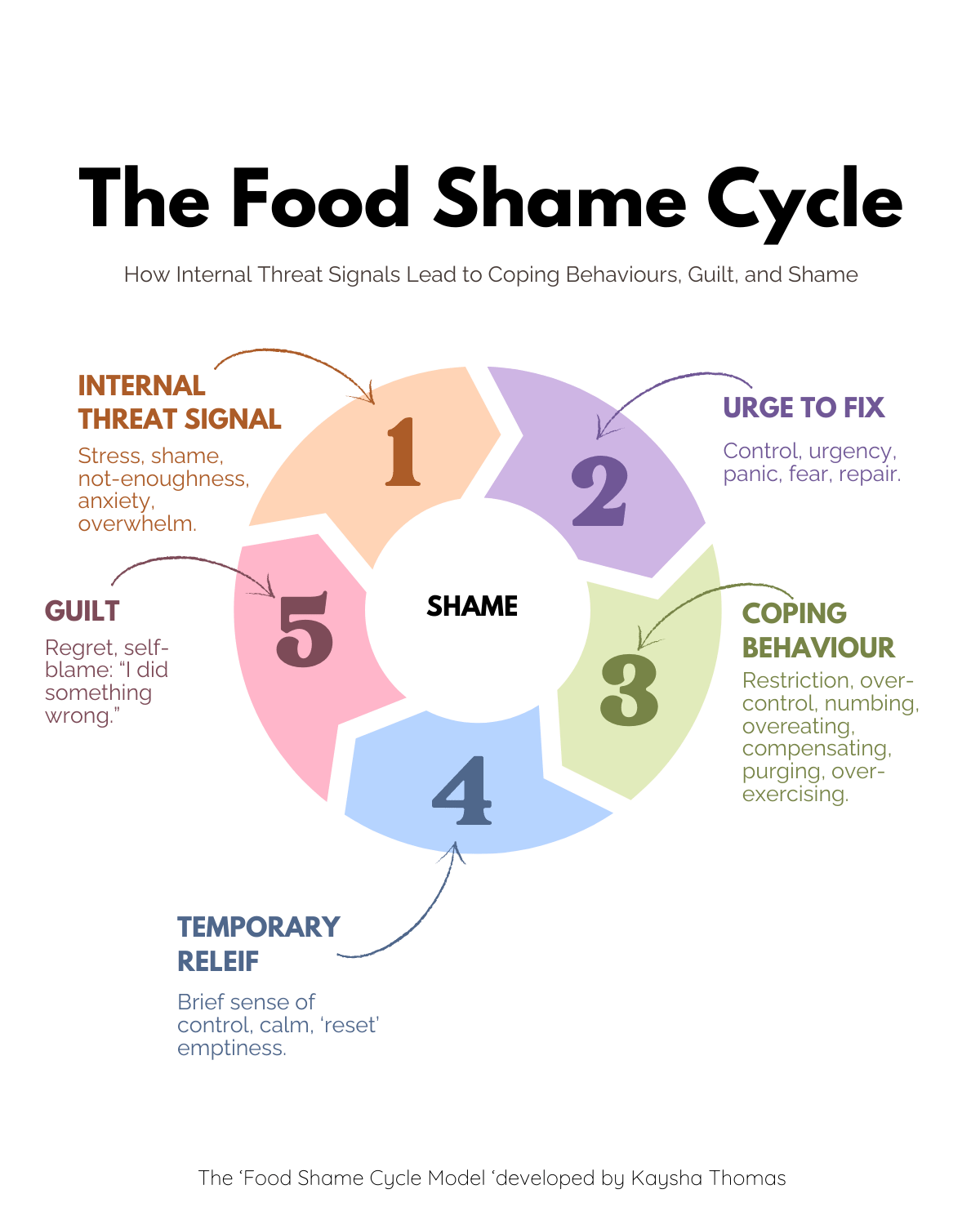
Figure: The Food Shame Cycle Framework (Thomas, 2026)
Why Shame Often Leads to Food Rules and Control
Research shows that those who have a long history of experiencing shame have a stronger stress response (Lupis et al, 2016).
When the body moves into that stressed state, the mind naturally becomes more focused on certainty and control. The nervous system is trying to stabilise discomfort quickly, so the brain starts scanning for ways to restore a felt sense of safety.
Food rules offer exactly that.
They give the mind something concrete to focus on:
“I’ll just eat better tomorrow.”
“I’ll be more disciplined.”
“I need to get back on track.”
In the moment, that can feel relieving because it creates the illusion that the problem has been solved.
But as always, it’s short-lived. The food rules are unsustainable; when the rules are broken or bent, that feeling of shame returns.
Your Willpower is no Match For Your Biology
You’d be forgiven for thinking this is a matter of sheer willpower. If you were to try again and try harder, things will be different. Things will be like the first time you ever dieted or followed a food rule. Many diets or restrictive food rules begin with what people often describe as a “honeymoon phase.” At first, the structure can feel motivating and safe.
But over time, the body and mind begin to adapt.
When food becomes restricted, the brain becomes more attentive to food cues and thoughts about eating often increase. At the same time, the rules themselves can create a growing sense of deprivation and mental effort. What initially felt manageable starts to require more and more energy to maintain.
You don’t feel truly safe with the food rules, but the thought of not having them feels unsafe too.
So when the rules eventually bend or break, it’s often interpreted as a failure of willpower. But in reality, it’s usually a sign that your body and mind are pushing back against prolonged restriction.
Willpower won't be enough here; this is a capacity issue. When you’re overwhelmed, overstimulated, under-rested, emotionally flooded, or carrying unprocessed stress, your window of tolerance shrinks.
The goal isn’t to force yourself to behave differently through sheer effort (as tempting as it feels). Rather, the goal is to find ways to increase your capacity to tolerate uncomfortable emotions without the need to “fix” them.
When food and exercise rules become your only way to cope, they keep you stuck in the same cycle.
How to Begin Interrupting the Shame Cycle
Not to sound like Captain Obvious over here…To break the shame cycle, you do have to do something different.
But it will take some patience, a lot of self-compassion and a little bit of faith that things can be different for you too.
Here are 3 things you can do to interrupt the shame cycle around food. Note: these do not need to be done all at once. You can choose to do them in the order I’ve outlined them below, or just start with the one that feels the most doable.
Either way, you’ll be interrupting that shame cycle.
It can be done!
1. Notice What Happens Before the Behaviour
Before the binge. Before the restriction. Before the purge….Pause.
Ask yourself: What is showing up for me right now?
You might connect to tension, urgency, numbness, tightness, a buzzy feeling. Sometimes you won’t feel anything clearly, and that’s still information.
So, whether or not you were able to connect to anything, can you stay here for a while?
Simple grounding techniques can help with this:
Feel your feet pressing into the floor
Wrap yourself in something that feels containing
Slowly lengthen your next exhale
Let your eyes orient gently around the room
The goal isn’t instant calm (although it may happen). What we’re trying to do is increase your capacity to stay with whatever is present.
We’re creating a buffer of a few extra seconds between the feeling thoughts and sensations and your reaction to them.
The pause only needs to be as long as you can tolerate. 10 seconds, 20, 30…Whatever feels doable, start there and gradually increase it over time.
2. Get Curious About the Inner Voice
If there’s one thing I wish I’d done differently when I first started working in eating disorder recovery, it’s not telling people to shut down their inner critical voice. Back then, it seemed logical. If the voice is cruel and shaming, the goal must be to get rid of it.
That approach is very outdated and I cringe when I think about the days I used that approach.
What I’ve learned since is that trying to silence the voice makes it louder. It leaves you feeling like there’s a battle going on in your head. Which makes you feel so tired, you end up giving in to the voice.
Instead, let’s get curious about this voice. Listen to what it has to say. Which is not the same as doing what it says.
Ask:
If I don’t follow this voice, what does it think will happen?
You will probably need to dig a little to get a meaningful answer. So whatever the response, ask again:
And then what? And then what? And then what?
A lot of the time it’s not trying to ruin your life (even if that is the outcome of its methods). There is usually something sitting at the core of its rules. More often than not, it’s fear.
Fear of not being enough
Fear of losing control
Fear of not being accepted
Fear of not being safe
And the tricky part is: those things probably matter to you too.
You want to feel secure
Capable
Successful
Safe
Instead of fighting the voice or blindly following it, you can ask:
What is this voice trying to create for me on a deeper level? Is there another way for me to move towards that… that doesn’t cost me my peace?
3. Reduce the Load to increase your capacity
Rather than rushing into fixing mode, we’re going to cultivate an environment that encourages healing. We do this by seeking other ways to help you bring a sense of ease to your body.
Ask:
Is there one small thing that could make this moment feel easier?
What would “good enough” look like in this moment?
What might help my body settle even a little?
And you don’t have to hold this on your own. If there’s someone safe, reach out. If there isn’t, consider whether you need to find a space where you don’t have to keep pretending you’re fine.
Progress Over Perfection
As I mentioned before, you don’t have to do steps 1, 2, 3 in perfect order. Start where you are and slowly build from there.
For many people, the food shame cycle has been reinforced over years…decades. It may have developed during times when control, discipline, or that harsh inner critic helped to keep you safe.
So change will happen slowly as you are moving away from familiarity disguised as safety.
Change will look like:
Increasing your awareness
Delaying the behaviour for a few more seconds
Speaking to yourself with less harshness
Shorter spirals
These shifts may seem small, but they create sustainable change. They add up!
Free Resource
I’ve created a free 4-page guide that walks you through these three shifts with prompts and grounding tools.
You can download it below.
If this pattern feels familiar, the next post explores the three emotional triggers that often start the shame cycle around food and food guilt. Recognising these triggers can help you interrupt the cycle before it gains momentum.
Sources:
Lupis, S. B., Sabik, N. J., & Wolf, J. M. (2016). Role of shame and body esteem in cortisol stress responses. Journal of behavioral medicine, 39(2), 262–275. https://doi.org/10.1007/s10865-015-9695-5
