
Why You Feel Out of Control Around Food (3 Food Triggers Nobody Talks About)
Feeling the weight of emotional eating and the persistent struggle with guilt and shame? Do you ever feel like you're on autopilot around food? Like, no matter how hard you try, you can't stop?
In this post, I want to walk you through three internal triggers that I see setting off the shame cycle around food on a weekly basis. These aren't the ones we commonly talk about; the comments about your body, the stressful social events, though those are very real too. These are the internal triggers that still end up taking over your food thoughts and take time out of your day.
If you’re new to this concept, you might want to read this first: What the Food Shame Cycle Actually Is (and Why It Feels So Hard to Break).It will give you the full picture of what we’re about to explore.
But before we get into the three triggers, let's talk about what's actually happening in your body when you are feeling triggered.
What Happens in Your Body When You're Triggered
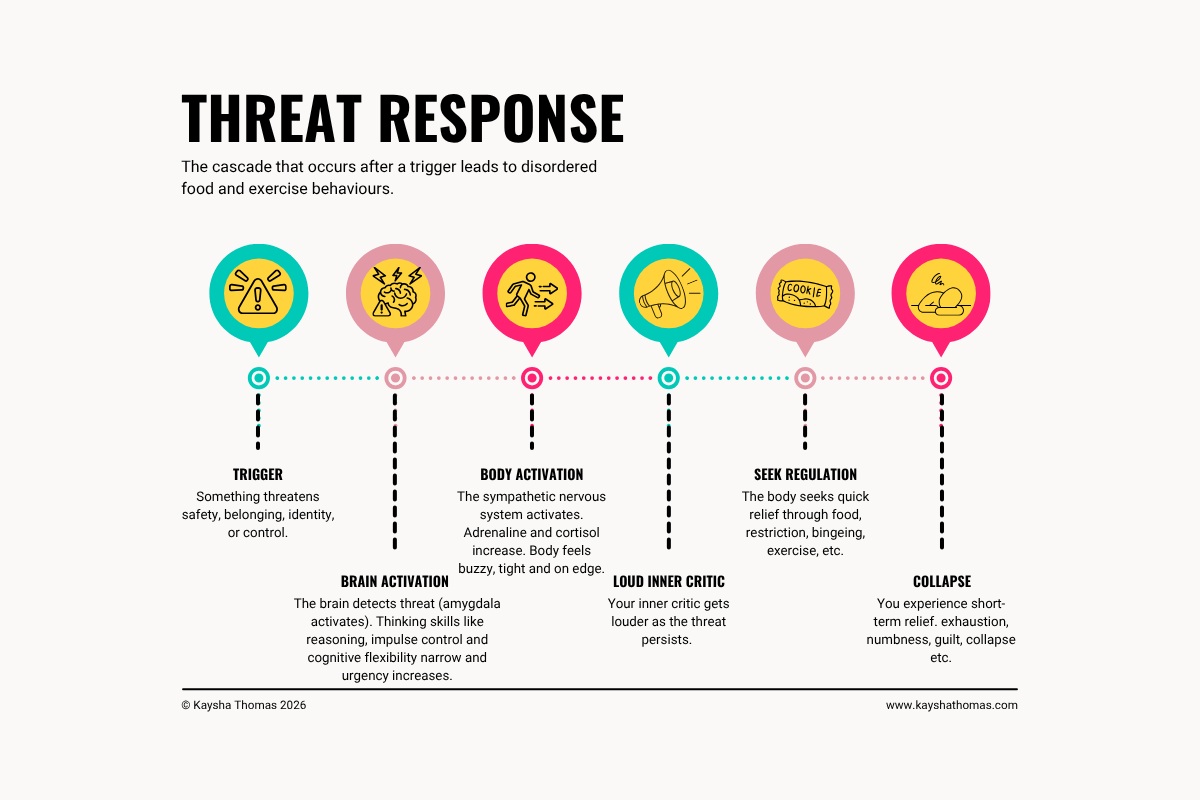
The word "trigger" gets used a lot these days, so let me be specific about what I mean here. A trigger is anything that is perceived as dangerous or threatening to your safety, your identity, your beliefs, or your sense of meaning. Crucially, there doesn't have to be a real, literal threat present.
It just has to feel like one.
When that happens, your nervous system shifts into survival mode.
Stress hormones like cortisol and adrenaline rise. Your body speeds up, you might feel buzzy, tight, or restless. And it that isn’t difficult enough the areas of your brain responsible for reflection, reasoning, and problem-solving become less effective.
Your brain is now focused on one thing only: getting you out of discomfort as quickly as possible.
This is why so many people describe their food behaviours as feeling like they "just lost control" or were "on autopilot." In many ways, that's actually true. Your body is trying to stabilise itself as fast as it can, and in that state, thoughtful decision-making goes out the window.
This is also why willpower will never be enough to solve this. Willpower doesn't stand a chance against the biology of your own nervous system. Your body is doing its most important job, protecting you. And for many people, food has become one of the fastest ways to feel safe again.
If you’ve ever felt stuck in that loop of trying harder, feeling worse, and starting again, I break that down in more detail here.
So with that in mind, let's look at the three triggers.
Trigger 1: Your Body Starts to Feel Undernourished
The first trigger is when your body hasn't been consistently nourished throughout the day (and this doesn't always look the way you'd expect).
Yes, it can be the more obvious signs of restriction. But it can also be much more subtle:
Delaying meals or skipping snacks
Stopping eating before your body feels fully satisfied
Eating mostly "safe" foods or high-volume, low-energy foods that leave your body wanting more
When nourishment is inadequate or inconsistent, your body reads that as a form of stress. It doesn't know when its next meal is coming, so it goes into food-seeking mode.
You might notice:
Food thoughts getting louder
Feeling hungrier than usual
Difficulty concentrating
A growing sense of urgency around food
And here's where the shame cycle kicks in. Those hunger signals, which are completely normal biological responses, can be interpreted as a personal failing. The thoughts sound like: Why am I so hungry? Nobody eats like this. I think about food too much. What's wrong with me?
But in reality, your body is doing exactly what it's supposed to do. It's trying to get its needs met. It's trying to help you survive. When those signals get filtered through a lens of shame, they reinforce the deep core beliefs you already hold about yourself, and that's what drives the cycle forward.
Trigger 2: A Food Rule Has Been Broken
The second trigger is one of the most common I see (and it can be incredibly destabilising).
Most people who struggle with food have rules, whether they're aware of them or not. They might be explicit: rules about what you're allowed to eat, when you're allowed to eat, and how much. Or they can be vague: I'm being good today. I'm going to do better than yesterday.
These rules serve a purpose.
They create a sense of structure and control, which can feel very grounding, especially when other parts of life feel chaotic or uncertain.
But when a food rule gets broken, even slightly, that sense of control shatters. And with it, the identity that the rule was helping to maintain: the person who is disciplined, in control, doing everything right.
When identity feels threatened, shame moves in fast. There's something wrong with me. I'm a bad person. I have no self-control. Those loud, harsh thoughts.
And at that point, behaviours like bingeing, purging, or restriction can feel like a way to disconnect from those feelings and to find relief from the discomfort. But the guilt attached to those behaviours then amplifies the shame even further.
What began as a momentarily broken rule quickly becomes a much deeper story about who you believe yourself to be at your core.
It's worth revisiting the difference between shame and guilt here, because they often travel together, but they are not the same thing:
Guilt is I have done something wrong: it's attached to a behaviour.
Shame is there is something wrong with me: it's a core belief about who you are.
Trigger 3: Your Needs Keep Coming Last
The third trigger is one that often surprises people. Let me know if it resonates.
You're the reliable one. The person everyone turns to. You make sure the people around you are okay, and you're genuinely good at it. But behind closed doors, there's loneliness. A quiet exhaustion. A feeling that no one has your back in the way that you have theirs.
Over time, that builds into frustration, resentment, and a deep sense of emotional depletion, feelings that often stay hidden because expressing them doesn't feel safe or acceptable.
And those feelings, the exhaustion, the resentment, the nobody really sees me, tap directly into core beliefs like: Nobody cares about me. Maybe I'm not enough. If they don't care about me, why should I?
In those moments, food becomes one of the most accessible ways to soothe that feeling. It can also become a way of expressing emotions that don't feel nameable out loud. Essentially pushing them down, numbing them out, finding comfort in the one thing that feels reliably available.
How to Respond to These Food Triggers
As you read through those three triggers, one or two may have felt very familiar. And if they did, they've likely been there for a long time, and food has been your way of coping for a long time, too. Maybe, at some point, it was the only coping mechanism you had.
Shame is incredibly persuasive. It makes those critical thoughts feel like absolute truth. But they're not the truth, they're old messages, likely passed down from someone else, repeated so many times that they've started to feel like fact.
Recovering from food struggles and body image struggles isn't just about getting rid of the behaviours. It's about resourcing yourself and giving yourself the tools to navigate difficult emotions, sensations and thoughts when they arise.
That might look like:
Therapy: working with someone who understands disordered eating and the shame that drives it
Community: finding a healing or recovery space where you feel less alone
Nervous system practices: learning tools that help your body come back to safety when things feel overwhelming
And if all of that feels like too much right now? That's okay. You can start exactly where you are.
Start with awareness and curiosity.
Now that you know this, the next time one of those moments comes up, you can meet it with compassionate curiosity: Oh, this might be one of those moments again.
And then ask yourself: Where did I learn this? Where did this belief come from?
Because I'd be willing to bet that belief didn't start with you.
