The Connection Between Nervous System Dysregulation and Disordered Eating
A commonly overlooked part of eating disorder recovery is understanding why disordered behaviours actually work. How restricting can create a sense of safety. How purging releases tension. How bingeing sedates and creates distance from feelings that feel too big to hold.
Well, that’s what this post is about. And what it means for how we approach recovery.
If you've ever thought:
"Why can't I just eat like a 'normal' person?"
"Why do I keep doing this even when I want to stop?"
"I know what I'm supposed to do, so why do I feel so stuck."
Well…
Whilst things feel chaotic, you are not out of control. Also, none of this is your fault.
I imagine that might be hard to believe right now, especially if you've been trying to "fix" this for a long time. But I hope that by the time you reach the end of this post, things will be a little clearer. And with that, a sense of a little more spaciousness to see a better future for yourself.
You may have tried recovery coaching, food tracking, meal plans, or rigid routines that overpromised and underdelivered, as you still found yourself cycling through the same patterns. What most of those approaches miss is this: your nervous system plays a central role in how you eat, how you feel in your body, and how safe (or unsafe) nourishment actually feels.
Which, by the way, is the reason why no one should be promising recovery within a set time frame, as no one can predict how long your nervous system needs to feel safe again.
But I’m getting ahead of myself. Let’s first make sure we’re all on the same page.
What is the Autonomic Nervous System?
Your autonomic nervous system (ANS) is your body's behind-the-scenes protection system. It runs continuously, without conscious thought, regulating your heartbeat, breathing, digestion, and how your body responds to perceived safety or threat.
When something feels overwhelming or dangerous (even if there's no visible danger), your nervous system responds automatically. You don't choose those responses. They happen beneath the level of thought, like a reflex shaped by everything your body has learned about what it means to be safe.
The ANS has two main branches:
The sympathetic nervous system: your mobilising branch. It activates when your body senses threat and prepares you to fight, flee, or take action. You might feel agitated, anxious, restless, or like you need to do something to make the feeling stop.
The parasympathetic nervous system: your rest-and-recover branch. When activated, it supports digestion, rest, connection, and a felt sense of ease. But this branch has two distinct modes:
A connected, regulated state: where you feel grounded, present, and able to engage with yourself and others
A collapsed, shutdown state: where the system powers down to conserve energy when a threat feels inescapable. This can look like numbness, dissociation, or a deep, heavy exhaustion
Your history shapes these responses, what your body has learned about danger and safety over years of lived experience and the environments you've moved through.
What Is Nervous System Dysregulation?
Dysregulation means your nervous system is stuck in survival mode. You might feel like you’re always on edge, like you're waiting for something to go wrong. Or chronically “meh”, like you're numbed out and can't quite find your way back. Or swinging between the two: flooded one moment, completely shut down the next.
In this state, your body is doing its number one job: seeking safety. The problem is that when your nervous system has been in survival mode for a long time, what feels safe is more about what is familiar. And that's where problematic eating behaviours may come in.
Dysregulation Isn't Always Personal
Chronic dysregulation isn't always, or only, the result of individual trauma or personal history. For many of us, particularly Black women, the nervous system is shaped by something much larger: the ongoing, everyday reality of navigating environments that have not always been safe.
Racial stress. Hypervigilance built over years of reading the room, managing others' discomfort, and making yourself smaller to move through the world more smoothly. The physiological weight of code-switching, of being perceived as "too much" or "not enough," of carrying your community's pain alongside your own. The exhaustion of being the one who keeps it together, keeps going, keeps showing up even when your body is screaming on the inside.
When you think about it, this is a very rational response to a world that has given your nervous system very good reasons to stay on guard.
Which means that healing your relationship with food is as much about learning to "listen to your body" as it is about understanding why your body learned to communicate the way it does. This will take giving yourself the compassion we’re not often afforded, yet we give to others so freely.
How Dysregulation Shows Up in Eating Behaviours
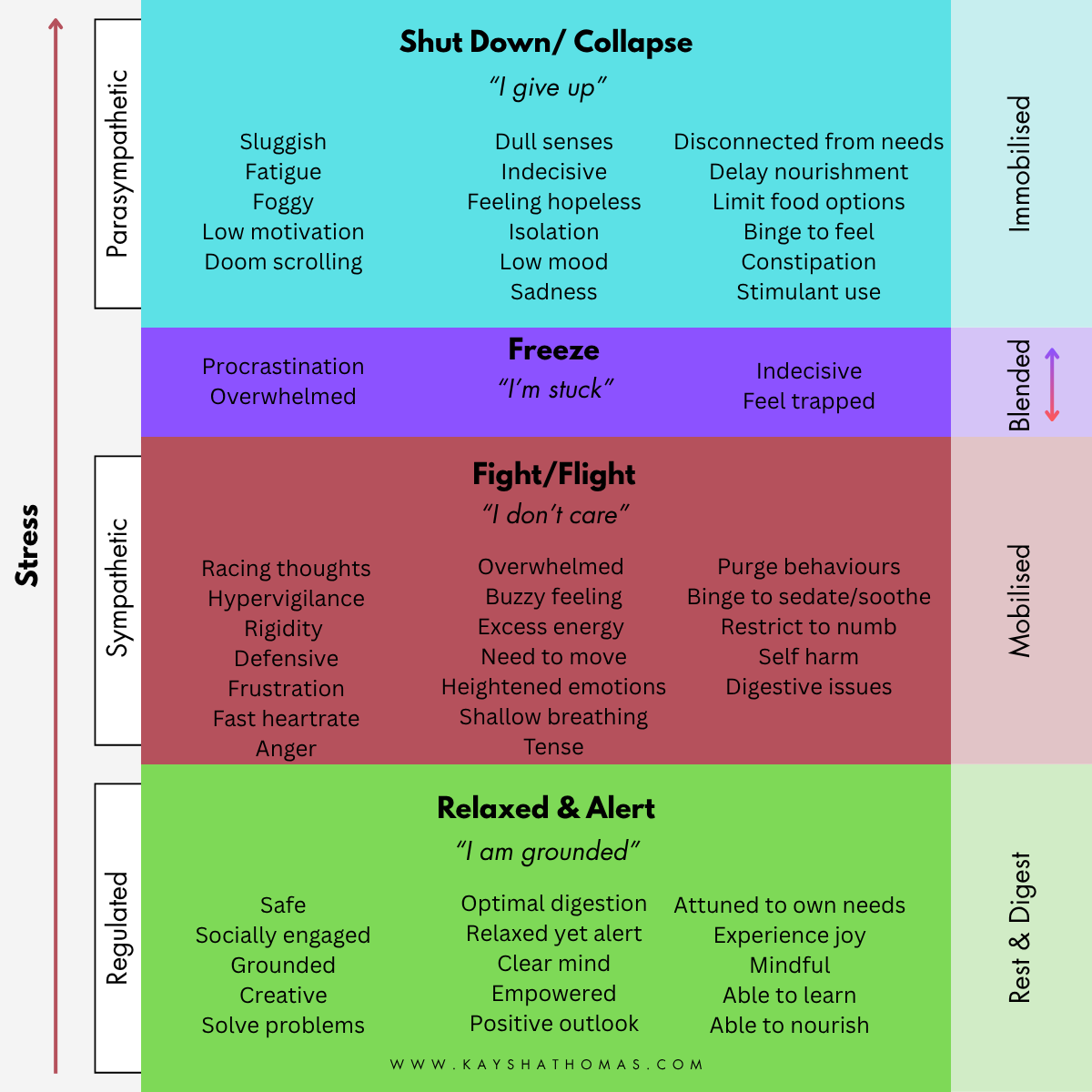
Our nervous system states shape everything: our emotions, our thoughts, our physical sensations and our relationship with food. Here's how each state can show up in the way you eat.
When You're in Fight-or-Flight
Your body is in “go mode” (mobilisation). Stress hormones like adrenaline and cortisol are activated, preparing you for action. You might feel restless, tight, buzzy, or like you're running on empty.
In this state, you might:
Binge to try to soothe the internal chaos
Feel an urge to "undo" or "fix" what you've eaten
Engage in purging or overexercise as a way to regain a sense of control or calm
Eat quickly or without noticing (e.g., on autopilot, barely tasting anything)
When You're Frozen
This is that stuck, paralysed feeling where there's internal tension, but you can't move through it. Like a deer in headlights. You might experience:
Mental fog or an inability to decide
Being overwhelmed by even the idea of preparing food
Standing in front of the fridge and closing it again without eating anything, several times in a row
When You're in Collapse (Shutdown)
When the system powers down completely, you might feel numb, sluggish, or deeply disconnected. Like there's a thick glass wall between you and everything (including your own needs).
You might:
Skip meals without noticing, because hunger doesn't register
Feel like eating requires more energy than you have
Be completely cut off from any sense of hunger or fullness
Binge as a way to feel something
When You're in Fawn Mode
Okay, whilst fawn isn't technically an ANS state, it's a learned survival behaviour, one that often develops in environments where conflict feels dangerous or where keeping the peace meant keeping yourself safe. It shows up as prioritising others' comfort over your own needs.
Around food, this might look like:
Eating past fullness so no one feels awkward or rejected
Not eating because no one else in the group is, and drawing attention to yourself feels unsafe
Choosing food based on what others expect rather than what you actually want
Saying yes when your body is saying no, or no when it's saying yes
Fawn can make it very hard to access your own needs at all. And if your needs were consistently treated as an inconvenience, then perhaps fawnning was the only way to survive.
I wrote about this in more detail in this blog post: How Suppressing Your Needs Impacts Your Relationship With Food & Body.
A note from practice
One pattern I've noticed consistently is how nervous system state shapes not just whether people eat, but what they reach for.
In states of sensory overload, when you’re already overwhelmed, food choices tend to become narrow. Bland, familiar, low-stimulation foods. This isn’t necessarily about preferance bu because there’s a need to reduce input into the body, not add to it. Crunchy foods can also serve a regulating function here; the repetitive sensation of chewing has a grounding, almost rhythmic quality that helps some people settle.
And across all states, bingeing can function as regulation in both directions; a way to feel something when you've gone numb, or to disconnect and sedate when you're feeling too much.
Why Restriction Fuels Dysregulation Too
Restriction is both a symptom and a cause of dysregulaion.
When the body is underfed, it enters a physiological stress response. Blood sugar becomes unstable. Cortisol rises. The sympathetic nervous system activates. Your body interprets not eating as a form of threat because, biologically, it is.
This means that restriction doesn't just reflect a dysregulated state; it actively maintains one. The more the system is in survival mode, the harder it becomes to eat in a way that feels safe and grounded. And so the cycle continues. This can often be mistakenly identified as lacking discipline, but in reality, it’s because your physiology is responding appropriately to a threat.
Which is why anyone promoting weight loss and nervous system regulation is a grifter (which definitely needs to be a blog post I write soon!)
Why Eating Feels So Hard When You're Dysregulated
When you shift into “fix your food” mode before understanding what’s actually going on for you in those moments, a few key things are missed:
You can't feel what you need. Dysregulation disrupts interoception, your body's ability to sense hunger, fullness, and satisfaction from the inside. Without this reconnecting back to that felt sense, eating becomes guesswork and it feels hard to trust your food choices.
Decision-making becomes harder. When you're in survival mode, the parts of the brain involved in planning, reasoning, and emotional regulation become harder to access. This is why something seemingly as simple as deciding what to eat can feel completely overwhelming.
Your digestive system is impacted. Stress affects digestion directly. You might feel bloated, nauseous, or physically tight before you've even started eating. Sometimes it may feel like there is no space for food.
Food becomes another source of overwhelm. When you're already at capacity, food brings extra sensory and emotional intensity (e.g. textures, decisions, memories, meaning). Avoiding it can feel like the only way to manage.
The fear of losing control. If you're afraid that once you start eating you won't be able to stop, that fear itself often leads to more restriction. This fuels the very dysregulation that makes the loss of control more likely. And so the cycle continues.

The Role of Self-Soothing and Regulation in Recovery
Bingeing, restricting, and emotional eating are adaptations. They're what your brain and body found, at some point, to manage an internal experience that felt unmanageable.
They're your nervous system saying: "I am not okay right now, and I am doing my best with the tools I have."
Understanding your food behaviours through this lens, is an important step in understanding other ways to support yourself when you are struggling. The way I see it is, even though the food behaviours aren’t serving you in the long term, they are still an attempt to meet a need. So, taking the behaviour away without any replacement leaves you with an unmet need.
Learning how to self-soothe
If you've ever tried to logic your way out of a binge urge, or do all you can just to push through a meal, you're not alone. And you've probably noticed: it doesn't work (at least not in the long term).
Remember: when you're deep in survival mode, the parts of your brain that respond to logic, planning, self-reflection, and emotional reasoning are harder to reach. Trying to reason with yourself out of a dysregulated state is a bit like trying to have a calm conversation with someone who's being chased by a wasp.
They’re not going to stop and listen. Trust me, I know this from experience!
Think of your nervous system like a frightened cat that's climbed up a tree. Yelling at it won't work. Forcing it down won't work. But if you sit nearby, patient, soft, non-threatening, borderline nonchalant even, eventually it climbs down on its own.
Your nervous system works the same way. It doesn't need to be pushed through the urge. It needs a felt sense of safety.
Small Practices That Support Regulation
By now you’re probably aware I don’t have any instant fixes. No “nervous system resets” here, I’m afraid. But there are small signals that let the body understand, you are safe enough right now.
Placing a hand on your chest, forehead, or belly and breathing into it
Exhaling slowly, a longer exhale than inhale activates the parasympathetic nervous system
Humming softly, or making a low sound on the exhale
Rocking gently or wrapping yourself in something warm
Naming five green things you can see around you (works with any colour)
These practices work because they engage the breath, the voice, and gentle touch, all pathways through which the body begins to register safety. The goal isn’t instant calm (that may happen), the goal is to send cues of safety to your body so that it eases up a little.
The Role of Co-Regulation
What individual self-soothing practices, and AI, can't fully replace: other people.
The nervous system is inherently relational. We evolved to regulate in community, through proximity, attunement, safe touch, and being truly witnessed. Co-regulation is when another person's regulated nervous system helps yours come back to its centre. It's why you feel calmer around certain people. It's why being seen and truly heard can feel like a massive weight has been lifted off your shoulders.
Community, genuine connection, and spaces where you can be fully yourself without code-switching or performing aren't luxuries. For nervous system healing, they truly are medicine.
Healing Is Non-linear
When you start doing this work, and you begin to loosen your grip on the behaviours that have kept you regulated, things can feel scary and messier before they feel better.
Whilst it can be tempting to go back to what’s familiar because this is (perhaps) the first time you’re not feeling disconnected from everything. You start feeling things, and that’s exactly what the eating disorder and disordered eating behaviours protected you against, feeling things. This is why we cannot rush recovery; it needs time as we heal in slowness.
Recovery also doesn't mean being regulated all day every day. It also doesn't mean never having another wobble here and there. Your nervous system will always be there, doing its thing in the background.
Life will continue to bring stress and uncertainty and heartbreak.
But what shifts is your capacity. You might still get dysregulated, but you return to yourself more quickly. You might still have hard moments with food, but they don't spiral in the same way, or for as long.
You start to notice:
I can pause before I act on this urge.
I can feel uncomfortable without it taking over.
I can offer myself care even when I don't feel good about my body.
You learn to work with your body instead of against it. And over time it becomes more and more familiar.
No, You’re Not Doing Recovery Wrong
If eating has felt confusing, chaotic, or out of your control, if you've blamed yourself for not having enough discipline, if you've wondered why recovery feels so hard even when you're doing all the "right" things:
You're not doing recovery wrong.
You're likely navigating survival with a nervous system that has been working incredibly hard to keep you safe. Probably for a very long time.
Your behaviours offered a sense of control, or comfort, or escape, in moments when nothing else felt available. There's no shame in the ways you have done your best to survive.
Shame is often what keeps the cycle alive. And the more you try to push through it or suppress it, the more it tends to show up. What actually supports healing is more compassion.
So we're not throwing out the whole toolbox and leaving you with nothing. We're slowly building new tools. Ones rooted in safety, in connection, in trust. Ones that support your body rather than punish it.
One step at a time. You’ll get there! But it will take time.
Ready to Take the Next Step?
I’ve created a gentle, practical resource to help you begin that shift:
The Nervous System Regulation Toolkit
A practical workbook to help you recognise your nervous system state and respond with care, especially in moments of food-related overwhelm.
Inside, you'll find support to:
Understand how different nervous system states show up in your eating
Explore how you personally experience those states
Choose regulation tools that actually work for your body
Build a personalised support plan for moments of anxiety, shutdown, or distress
You can purchase the workbook here.